Usually, not in the same way woven fabrics do.
That is the key point to understand before anything else. Knit fabrics can get damaged, stretch out, curl at the edges, develop holes, or start unravelling in certain spots, but many of them do not fray with that classic loose-thread edge people expect from woven cloth. So if someone cuts a knit fabric and waits to see a messy fringe of threads, they may not see much at all.
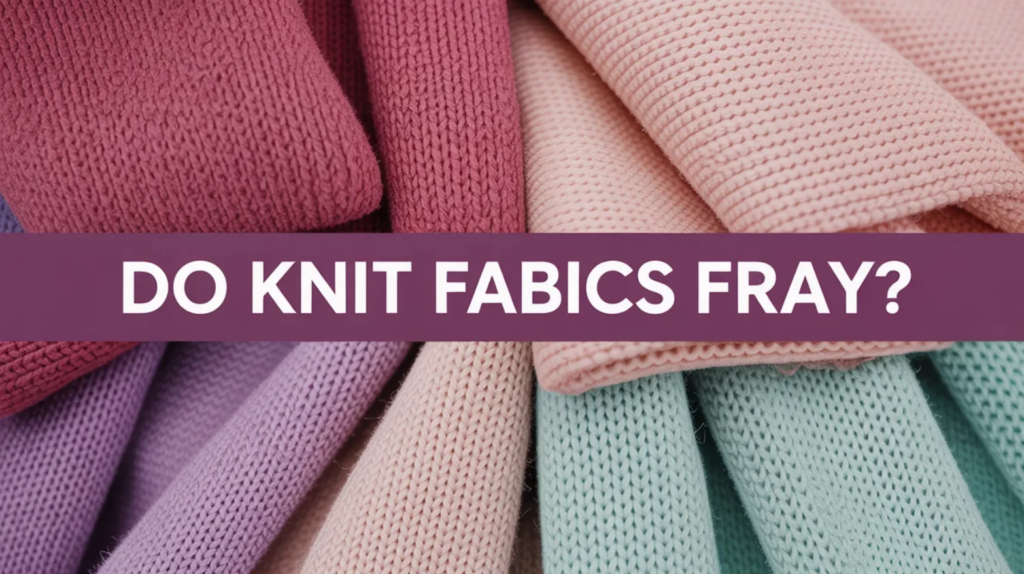
This is exactly why knit fabric behaves differently from other fabric types where fraying depends heavily on structure, fibre, and weave. With knits, the bigger risk is often edge distortion or unraveling loops rather than a traditional frayed border.
Why knit fabric behaves differently
A knit is made from interlocking loops rather than the criss-cross woven structure found in many other fabrics. Because of that looped construction, the cut edge often reacts in a different way. Instead of shedding individual threads from a woven grid, the fabric may curl, roll, stretch, or start loosening along the loops.
That difference matters. When people ask whether knit fabric frays, they are often really asking whether the edge will fall apart after cutting. For many knits, the answer is not “yes, it frays,” but rather “it may curl, ladder, or become unstable if left unfinished.”
So is the answer no?
Not completely. Some knit fabrics can still show fraying-like edge wear, especially if they are loosely knitted, blended with other fibres, or heavily used. But the behaviour is usually less about neat threads pulling away from a woven edge and more about the fabric structure losing control.
In everyday sewing and repair terms, this means knit fabrics are often easier to cut without immediate edge chaos, but they come with a different set of problems afterward.
What usually happens to a raw knit edge
In many cases, the edge curls inward or outward. Jersey is a common example. Instead of turning fuzzy right away, it tends to roll at the cut line. Other knits may stay relatively calm at first but stretch out of shape with handling. Some can start unlooping if a weak point forms and the structure begins to run.
So while a woven cotton edge may look feathery after cutting, a knit edge may look rolled, warped, or slightly loose without producing the same obvious fringe.
When knit fabric can still become a problem
Knit fabric becomes more vulnerable when it is very loose, lightweight, or repeatedly stretched. Areas under tension, such as necklines, cuffs, hems, side seams, and sleeve openings, can become worn or distorted over time. Once the loops start weakening, the damage can spread in a different way from ordinary fraying.
Older knit garments also tend to lose resilience. A T-shirt that has been washed and worn for years may not fray like linen or rayon, but it can thin out, curl badly at the edge, or start breaking apart where the fabric has been strained.
Knit fabric versus woven fabric
This is where confusion usually starts. A woven fabric often frays because threads separate from the edge. A knit fabric often misbehaves because loops move, roll, stretch, or unravel. Both can look untidy, but the mechanism is not the same.
That is why knit fabrics often feel easier to cut casually than something like rayon, which tends to lose edge threads much faster once the cut line is exposed. Rayon often punishes delay with visible thread loss. Knit fabric more often punishes delay with shape problems or unraveling sections.
Do all knit fabrics resist fraying equally?
No. A firm double knit can behave very differently from a soft jersey. Rib knits, sweater knits, interlock knits, and athletic knits all have their own level of edge stability. Some are quite forgiving and stay usable even with a raw edge. Others become annoyingly unstable the moment they are cut.
The fibre also matters. Cotton knit may behave one way, polyester knit another, and a stretchy blend with elastane may react differently again because the fabric wants to pull and recover at the edge.
Can knit fabrics unravel even if they do not fray much?
Yes, and this is often the more important concern. A knit may not create a classic fuzzy edge, but if one loop breaks in the wrong place, the surrounding rows can begin loosening. On some fabrics, this looks like a run, a ladder, or a stretched-out line that keeps worsening.
So someone checking for fraying may think the edge is safe, while the real risk is that the knit structure itself is starting to fail.
Should knit edges still be finished?
Often, yes, especially for garments or items that will be washed, worn, and stretched repeatedly. Even when a knit does not fray much, an unfinished edge may curl, twist, or become messy over time. That can affect both appearance and durability.
Some knit fabrics are intentionally left raw for style, but that only works well when the specific fabric is stable enough for it. On unstable knits, a raw edge can quickly stop looking intentional.
What are the warning signs?
If the cut edge starts rolling hard, stretching wider than expected, developing a run, or looking thin and stressed, it is telling you the fabric is not as stable as it first seemed. A knit does not have to produce loose threads to be in trouble. Distortion is often the earlier warning.
Likewise, if a seam area begins looking wavy or the loops around the stitching appear pulled open, the problem may be developing from tension rather than classic fraying.
So, do knit fabrics fray?
Usually not in the traditional woven-fabric sense. Most knit fabrics are more likely to curl, stretch, or unravel than to form a typical frayed edge with lots of loose threads. That said, they are not automatically safe once cut. Some knits can still wear down, become unstable, or start running if the edge is left unsupported.
In simple terms, knit fabrics often avoid the usual kind of fraying, but they replace it with a different edge problem. So the raw edge may look better at first, yet still need attention before wear, washing, or stress turns it into a bigger issue.