Every piece of fabric carries a silent history of movement, pressure, and use.
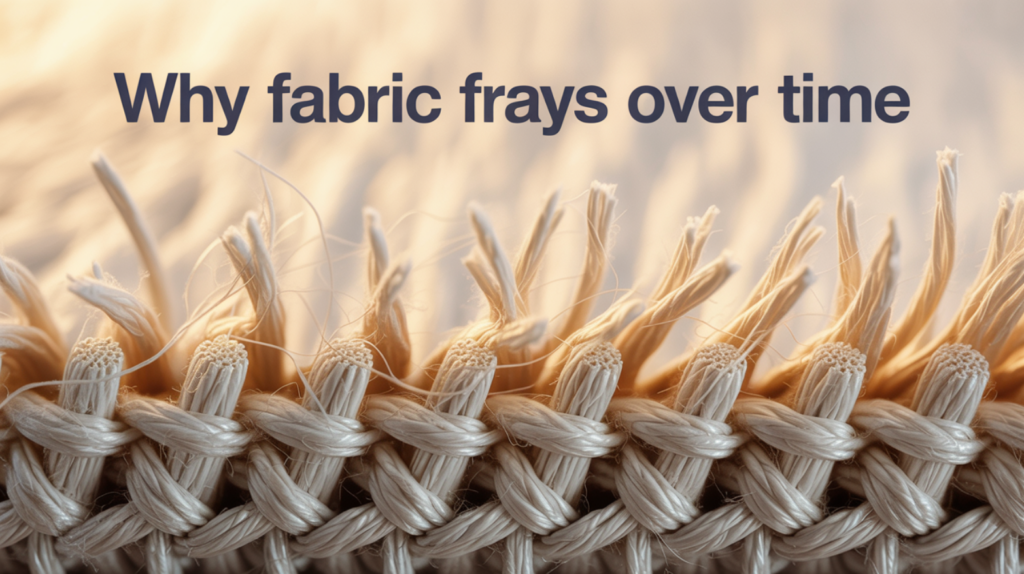
This article explores how that history gradually shapes the condition of textiles, revealing why fraying appears slowly over time and how daily habits quietly influence the lifespan of everything you wear and use.
The Quiet Process Behind Fabric Breakdown
Fabric frays over time because the fibers that hold the cloth together slowly lose their grip under constant stress.
Every movement, wash cycle, stretch, and surface contact places pressure on the fabric’s internal structure.
At first, this stress is invisible.
The garment still looks normal.
But inside the weave, the bonds between fibers are weakening.
Fabric fraying occurs when the structural tension of textile fibers gradually deteriorates through repeated mechanical stress.
This process unfolds quietly and continuously during normal use.
How Daily Use Slowly Weakens Fabric
Fabric survives by maintaining tension between its fibers.
That tension allows it to flex without breaking.
However, every time you sit, walk, wash, fold, or stretch a garment, the fibers absorb microscopic damage.
Over weeks and months, this damage accumulates.
As a result, fibers begin separating from the weave.
Once that separation begins, the edge of the fabric becomes unstable, the same phenomenon explained in what is fabric fraying, where early fiber separation leads to visible unraveling.
Why Time Makes Fraying Inevitable
Time multiplies stress.
A shirt worn once a week ages slowly.
A pair of jeans worn daily ages much faster.
The difference is not the fabric itself but the frequency of strain placed upon it.
As stress compounds, friction increases.
As friction increases, fiber bonds weaken further.
This accelerating cycle explains why older garments fray more easily than newer ones.
Why Washing Accelerates the Fraying Process
Water loosens fibers.
Detergent reduces friction control.
Mechanical agitation bends and twists threads under pressure.
Together, these forces cause fibers to swell, shift, and rub against each other.
With each wash cycle, the weave loses a small amount of its original strength.
This is why hems, cuffs, and seams, the zones already under high stress, are the first areas where fraying becomes visible.
Why Fraying Speeds Up Once It Begins
Once fibers start escaping the weave, the fabric loses its internal balance.
That imbalance makes neighboring fibers more vulnerable to movement and friction.
As a result, fraying accelerates.
Without early intervention, the damage spreads steadily inward until the fabric can no longer support normal wear.
Understanding the specific triggers behind this acceleration becomes easier when reading what causes fabric edges to fray, which explains how stress concentrates at exposed edges.
The Emotional Side of Watching Fabric Age
There is something quietly painful about watching a favorite garment grow old.
Not because it stops working, but because it slowly loses the form and confidence it once had.
Recognizing that fraying is part of a natural aging process, and that you can slow it, restores a sense of control and care over the things that serve you every day.
Conclusion
Fabric frays over time because repeated physical stress gradually weakens the bonds that hold fibers together.
This is a natural process of material aging, but one that can be delayed and managed through proper handling and timely reinforcement.