Outdoor fabric fraying is the progressive breakdown of fibers caused by prolonged exposure to sunlight, moisture, wind, temperature changes, and mechanical stress.
Unlike indoor textiles, outdoor fabrics remain under continuous environmental pressure, which slowly weakens the weave and releases individual threads from the surface and edges.
On FabricFraying.help, this category represents the most aggressive fraying environment because no other fabric type faces so many destructive forces at once.
Why Outdoor Fabrics Deteriorate Faster Than Indoor Textiles
Outdoor materials live in constant tension with their surroundings.
Sunlight applies ultraviolet radiation that weakens fiber bonds.
Moisture penetrates the weave, causing swelling and contraction as humidity changes.
Wind introduces continuous motion that rubs fabric against poles, frames, and surfaces.
Temperature fluctuations further stress fibers as they expand and contract.
Over time, these combined forces reshape the weave and reduce its ability to retain structural integrity.
Common Fraying Zones on Outdoor Fabrics
Damage concentrates where environmental forces converge.
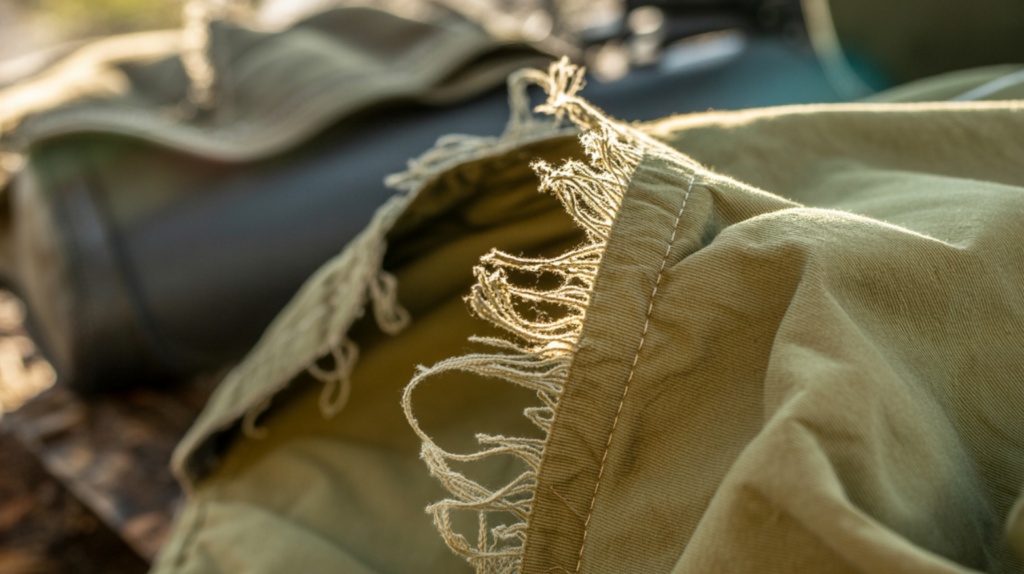
Tent seams fray because fabric flexes repeatedly under wind pressure.
Awning edges fray because they remain fully exposed to sunlight and airflow.
Protective covers fray at corners and tie-down points where tension remains highest.
Each of these zones follows the same underlying mechanism: environmental stress weakens the weave until fibers escape.
How Outdoor Fabric Material Influences Fraying
Material selection plays a major role in longevity.
Natural fibers degrade quickly outdoors due to moisture absorption and biological breakdown.
Synthetic fabrics behave differently; in outdoor applications, polyester can fray more slowly from moisture but becomes increasingly vulnerable under prolonged ultraviolet exposure.
Coated fabrics, UV-resistant treatments, and dense weaves significantly slow the progression of fraying.
Early Warning Signs of Outdoor Fabric Fraying
Subtle indicators appear before major failure occurs.
You may see fuzz forming along seams.
You may notice stiffness or thinning in sun-exposed areas.
You may observe threads lifting where tension concentrates.
These changes signal that fiber structure is weakening and requires intervention.
Practical Ways to Slow Outdoor Fabric Fraying
Prevention begins with environmental management.
Storing fabrics when not in use reduces UV exposure.
Cleaning debris and salt residues prevents chemical breakdown.
Using protective sprays adds a barrier against moisture and sunlight.
Reinforcing seams and stress points strengthens vulnerable zones.
Selecting fabrics specifically rated for outdoor use provides the strongest foundation for long-term durability.
How Outdoor Fraying Fits the Larger Fabric System
Although outdoor fabrics face harsher conditions, they follow the same principles explained in fabric fraying by use case.
In every scenario, repeated stress reshapes the weave until fibers escape.
Understanding this shared behavior allows consistent prevention strategies across all fabric environments.
Conclusion – The Core Reality of Outdoor Fabric Fraying
Outdoor fabric fraying is the natural consequence of environmental exposure acting on textile structure over time.
Once ultraviolet radiation, moisture, and motion weaken the weave, unraveling accelerates unless the fabric is protected and reinforced.
This is not product failure, it is the predictable life cycle of fabric in nature.
Recognizing it gives you the power to extend the life of your outdoor equipment dramatically.