Linen is a natural fabric made from flax fibers, valued for its cool feel, crisp texture, and breathable structure.
Yet beneath that elegance, linen hides one of the most fragile relationships between fiber and weave. Linen fibers are long, rigid, and smooth, which gives the fabric its distinctive look, but that same rigidity makes linen particularly vulnerable to fraying once stress enters the picture.
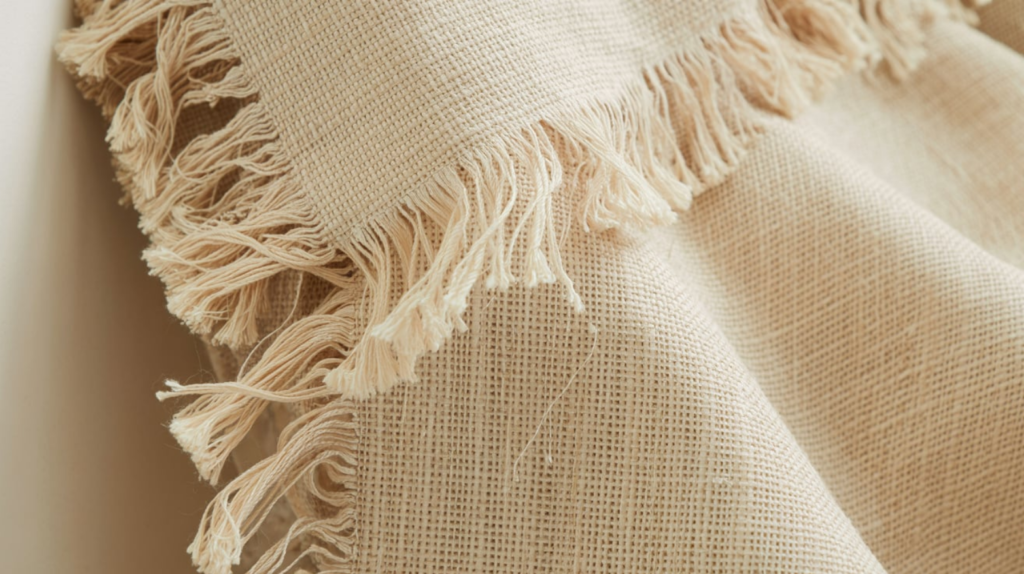
This is why linen garments often feel strong when new, then suddenly begin to unravel at the edges after surprisingly little wear.
Why Linen Frays So Readily
Unlike cotton, whose fibers soften and relax with use, linen fibers remain stiff and resistant to bending.
When the fabric is folded, stretched, or rubbed, the fibers cannot absorb movement as easily. Instead, tension concentrates at the points where threads intersect, causing micro-breaks that slowly work their way toward the fabric’s edges.
As these tiny fractures accumulate, the weave begins to open. Individual fibers then slip free, forming the familiar frayed edge that appears along hems, seams, and high-movement zones.
This breakdown behaves very differently from the slow loosening seen in cotton fabric fraying problems, where flexibility delays visible damage.
Common Linen Fraying Locations
Linen fraying almost always appears first where fabric experiences repeated bending or tension:
- Shirt cuffs and collars
- Trouser hems
- Tablecloth corners
- Seat areas in linen upholstery
Every fold places stress on fibers that do not bend easily. Over time, that stress weakens the internal structure, and the fabric begins to separate at the edges.
Washing accelerates the process. Water stiffens linen fibers as they dry, locking new fractures into place with each cycle. Heat further dehydrates the fibers, making them even less tolerant of motion.
How Linen Fraying Limits Fabric Longevity
Once linen begins fraying, the process tends to move quickly.
The rigid fibers do not redistribute stress the way softer fabrics can. Instead, the damage concentrates in narrow zones, allowing frayed edges to extend deeper into the fabric with each movement.
This explains why linen items often appear to fail suddenly after only modest wear. The internal structure has been quietly weakening long before the first loose thread becomes visible.
These patterns align closely with the larger framework of fabric fraying by material type, where each material’s natural properties dictate its aging behavior.
How Linen Fraying Compares With Other Materials
Linen’s rigidity places it at the opposite end of the spectrum from elastic fibers like wool.
Where linen cracks under repeated bending, wool fibers stretch and recover, delaying visible fraying, a contrast explored further in wool fabric fraying solutions.
Understanding these differences reveals why material choice alone can determine how long a garment remains intact.
Conclusion
Linen fraying occurs because stiff flax fibers cannot absorb motion and stress without breaking.
Once micro-fractures begin forming, the fabric’s weave opens, and fraying becomes unavoidable.
Linen is beautiful, breathable, and strong, but it is not forgiving.