
Clothes fraying at the edges is the gradual release of threads along hems, cuffs, seams, and openings of garments caused by movement, friction, and repeated washing.
When fabric edges are exposed to stress without reinforcement, the weave loosens, fibers shift, and threads escape.
This process does not happen suddenly; it develops quietly with each wear and wash until visible damage appears.
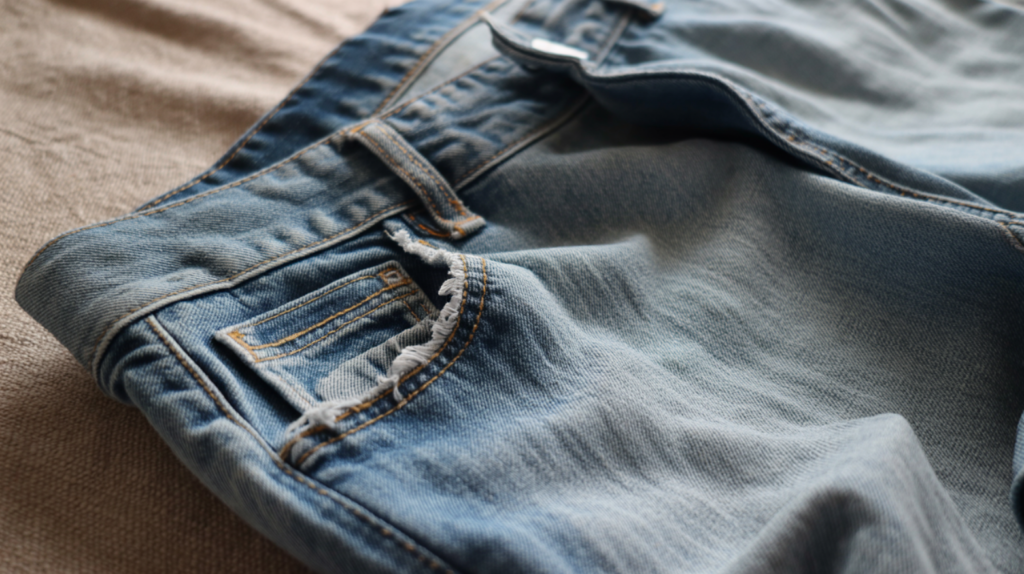
On FabricFraying.help, this topic represents one of the most common real-world fraying scenarios because clothing experiences constant motion against skin, furniture, and other materials.
Why Clothing Edges Fray First
Every garment contains structural tension.
That tension concentrates at edges because seams mark where the fabric ends and the weave loses internal support.
As the garment moves with the body, these zones experience repeated pulling and bending.
Over time, washing adds another layer of stress.
Water weakens fibers temporarily, detergent removes protective residues, and spinning cycles stretch the fabric outward.
As a result, hems and cuffs slowly release individual threads, which then catch on surrounding surfaces and accelerate the unraveling process.
This is why edge fraying often appears first, even when the rest of the garment still looks new.
Common Locations Where Clothing Frays
The pattern of movement determines the pattern of damage.
Hems fray because they drag against legs, chairs, and floors.
Cuffs fray because wrists and ankles flex continuously.
Necklines fray because fabric bends and stretches during every wear.
Pocket openings fray because fingers apply repeated friction in the same small area.
Each of these locations follows the same underlying mechanism: stress weakens the weave, loose threads emerge, and contact multiplies the damage.
How Fabric Type Influences Edge Fraying
While usage creates the problem, material choice determines its speed.
Natural fibers absorb moisture and swell during washing, which changes the tension inside the weave.
Synthetic fibers behave differently; for example, when it comes to daily garments, polyester can fray more slowly in washing but becomes vulnerable when exposed to heat and abrasion from dryers and rough surfaces.
Likewise, cotton fabric fraying problems appear sooner on lightweight shirts because thin cotton fibers lose cohesion faster at the edges.
This interaction between fabric structure and garment movement controls how quickly edge damage becomes visible.
Early Warning Signs to Watch For
Before visible holes form, the fabric sends subtle signals.
You may notice soft fuzz collecting along hems.
You may feel roughness where smooth fabric once existed.
You may see individual threads extending slightly beyond the seam.
These early changes indicate that the weave is loosening.
Catching them at this stage allows you to reinforce edges before the damage becomes permanent.
Practical Ways to Prevent Edge Fraying in Clothes
Prevention begins with stabilizing the edge.
Reinforced stitching strengthens the boundary and distributes stress.
Gentle washing reduces fiber swelling and shrinkage.
Turning garments inside out minimizes friction against other clothes and machine surfaces.
Air drying prevents heat damage that weakens thread structure.
Beyond washing habits, garment selection also matters.
Well-finished seams, bias tape, and double-stitched hems create stronger edges that resist unraveling longer.
How This Use Case Connects to the Bigger Picture
Edge fraying in clothing represents one branch of the broader fabric behavior explained in fabric fraying by use case.
Although the environment differs from furniture, bedding, or outdoor materials, the core principle remains the same: stress reshapes the weave until fibers escape.
Understanding this relationship allows you to apply similar prevention logic across every textile in your life.
Conclusion – The Core Reality of Edge Fraying in Clothes
Clothes fraying at the edges is the visible outcome of repeated motion, washing, and contact acting on the most vulnerable parts of a garment.
Once the weave loosens at those boundaries, damage progresses steadily unless the edge is reinforced.
This is not random wear, it is a predictable response of fabric to everyday life.
And once you understand that, you gain control over how long your clothes truly last.